Words As Nature Intended: Embracing the Organic Text Revolution
Jeremy Jules Edwards, 100% Human Writer

Jeremy Jules Edwards - Content Writer
I love to write almost as much as I love to read. With a background
in teaching, I break down complex information into
digestible, actionable content that instructs and inspires.
Whether it's health & wellness tips, trends in psychedelic therapy, or meditative essays on social media and the prospect of a dead internet, I'm always expanding my knowledge base.
Research-backed and search-optimized, I deliver projects on time that are meticulously copy-edited. My clients get returns, and they return.
jjulese@outlook.com
Why I'm a "100% Human Writer"

Having worked intimately with AI writing tools, for both professional and personal projects. I find that LLMs, quite frankly, make the process of writing harder than it needs to be.
More egregiously, they're notoriously soulless, riddled with cliches, and if we're thinking about brand engagement, utterly forgettable.
In fact, when GPT technology was being developed, researchers dubbed the output of their glorified autocomplete machines as synthetic text. And your audience can smell it a mile away.
Have you ever received an obviously ChatGPT-composed email or text and felt, well, rather insulted?
It doesn't just insult your intelligence--it's an act of radical disrespect to your very humanity. But here's where it gets interesting: not only is your anger totally valid, you've masterfully articulated something rarely noticed by society. I'm sensing big MENSA vibes over here...
If you can smell it -- through the low-stakes of a personal exchange -- imagine your customers reading your glib, Claude-composed slop of a newsletter, blog post, or Instagram caption, and how they might reconsider their relationship with a brand.
I am not a Luddite, nor do I deny that these tools do have their uses. But using them for creative tasks and cognitive insights (eg. your marketing funnel) all but guarantees mediocrity.
Because they are probabilistic, as in they choose the next word that's statistically likely to follow the previous ones (eg. your prompt), all large language models regress to the mean. Average. Fine. Mid.
And forget about fiddling and fixing the output, or an LLM's affinity to hallucinate, to shamelessly fluff and stuff word counts, like an essay rushed to a professor's inbox at 11:59 pm.
Forget its fondness for authoritatively stating false (and often dangerous, even homicidal) medical and mental health misinformation.
Forget the messy ethical implications, the countless authors, artists, and programmers' labor all scraped by venture capital to train their models, for zero compensation, let alone attribution.
Forget about taste. Forget
even about the data centers, the culture wars, the declining literacy
rates and rising cognitive debt from outsourcing your frontal lobes to a server farm.

Massachusetts Institute of Technology
OK, you're running a business. So why pay a human writer vs. using a (heavily subsidized) LLM subscription?
Not only are your $20/month "pro" Claude account prices heavily subsidized and their days numbered, in early March, Goldman Sachs released a memo on its 2025 market data, and the headline was as serious as a heart attack:
In 2025, there were only two (2), significant ROIs to enterprise-level AI capex and SAAS expenditures, contained to highly specific labor outputs--customer service and coding (I also strongly recommend a peak at Sec. 6.3 of this sobering MIT NANDA study from last year.)
But the Sachs report flatly concluded what many have long suspected -- at this time, there is:
"No meaningful relationship between AI and productivity at the economy-wide level."
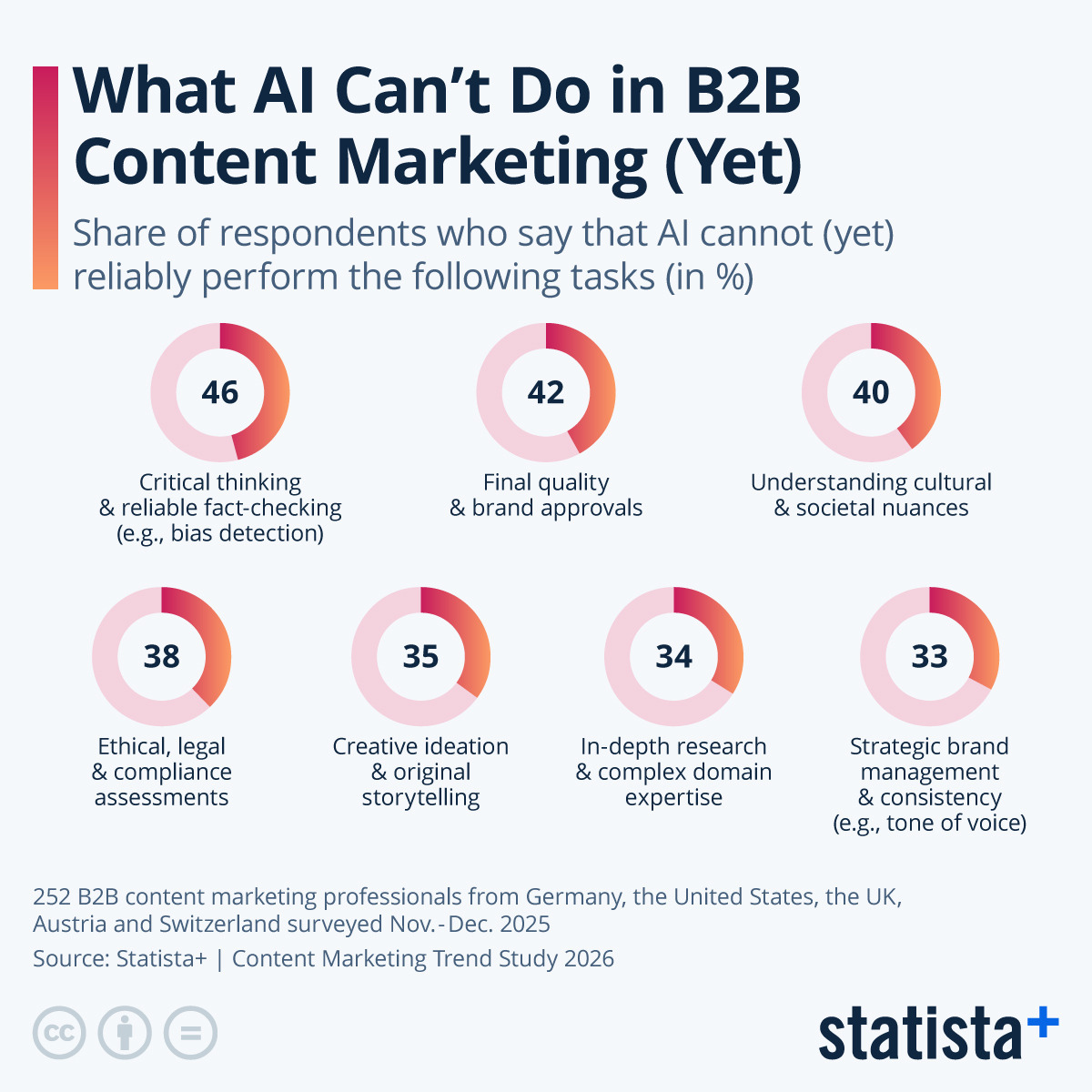
Survey of 252 Content Marketing Professionals on the Efficacy of Ai-Generated Content Makreting
Publishing content that genuinely helps, inspires, and builds trust with your audience, is an excellent opportunity to demonstrate the integrity of your brand.
This is especially true in a economic climate of greed, vaporware, rug-pulls, and a feeling the US economy is just three corporations stacked in a trench coat.
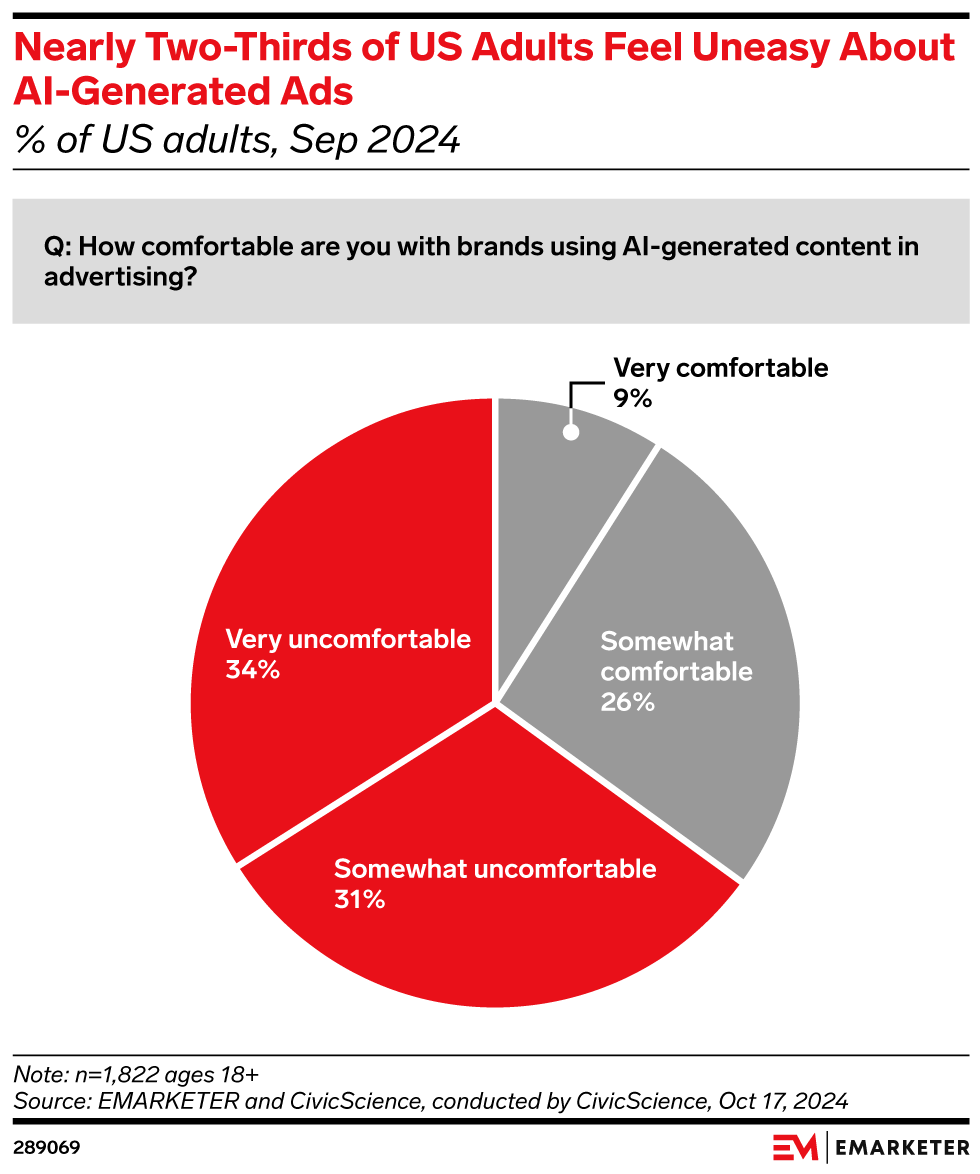
In digital marketing, brand authenticity is more relevant than ever, especially as consumers become increasingly frustrated with the quality of Google Search, not to mention the backlash to Prada's AI-generated adverts.
In fact, a Texas university published a paper on the business implications of Prada's AI-driven campaign, highlighting its marketing objective failures.
Focusing on the implications of taking short cuts, especially as it relates to a global luxury brand, using generative-AI image diffusion models instead of real photography, their research concluded:
"AI-generated advertisements are perceived to be made with lower effort."